About the Journal
Ufuk: Journal of Indonesia–Türkiye Studies is an open-access, peer-reviewed journal dedicated to fostering intellectual exchange between Indonesia and Türkiye in the fields of the social sciences and humanities. Metaphorically, “Ufuk” (Turkish for horizon) signifies intellectual vitality, breadth of understanding, forward-looking vision, and openness to new perspectives. Embracing this ethos as its scholarly mandate, the journal aspires to cultivate a shared academic space in which Indonesia and Türkiye—conceived as two intersecting horizons of thought—engage in mutual expansion through critical reading, dialogue, and learning.
The journal invites original scholarly contributions, including but not limited to empirical research articles, theoretical analyses, diaspora-based field notes, policy briefs, annotated translation dossiers, and critical book reviews. Submissions that do not directly address a specific thematic focus but remain aligned with the journal’s Focus and Scope will also be given due consideration.
Current Issue
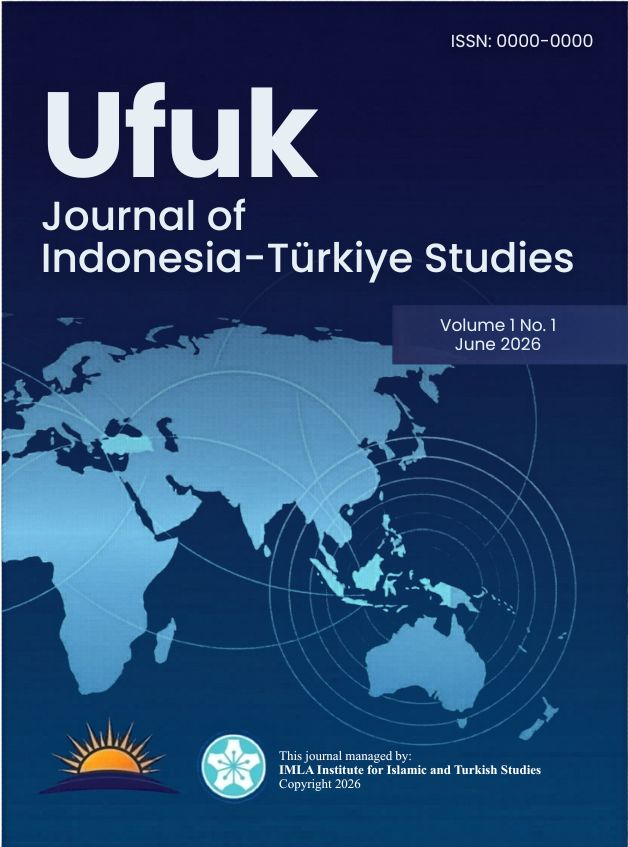
This inaugural issue of Ufuk: Journal of Indonesia–Türkiye Studies, published under the theme "Everyday Indonesia–Türkiye Encounters," opens with a Field and Diaspora Notes contribution by Mohammad Muafi Himam and Taufiq Ismail, who draw on Bourdieusian concepts of habitus and capital to trace the intellectual transformations of Indonesian students immersed in Turkish İlahiyat faculties. Azzam Ghufrani and colleagues then situate Elmalılı Hamdi Yazır's Hak Dini Kur'an Dili within a Gadamerian framework, tracing how its interpretive horizons continue to resonate in Indonesian Qur'anic studies. Abdul Rilan Syarif offers a comparative policy analysis of deposit insurance systems in Indonesia and Türkiye, demonstrating that SDIF's risk-based premium architecture produces a markedly superior deposit protection ratio and arguing that Indonesia's forthcoming reform milestones constitute an urgent window for transition. Jelang Ramadhan's geopolitical analysis of Turkey and Russia's Indo-Pacific orientations argues that Türkiye's regional engagement reflects a deliberate soft-power recalibration in which Indonesia figures as a pivotal node. The issue closes with a Book Review by Dina, whose reading of İbrahim Kalın's Ben, Öteki ve Ötesi reframes the Islam–West encounter as a long, layered negotiation between self and other, a fitting coda to an issue animated throughout by the question of what it means to meet across difference.